More parts on every sheet. The sheet off the machine sooner.
Logix is the true-shape nesting engine built into PolygonLogix. Older engines place parts one at a time and never move them again. Logix puts every part on the sheet at once, then squeezes the sheet while the parts push each other apart until nothing overlaps. It is the method behind most of today’s published records for irregular nesting, and it runs on every core of the PC you already have.
The Logix engine is in every edition: Lite in your browser, Standard and Pro on the desktop. Features marked below need the desktop program or Pro.
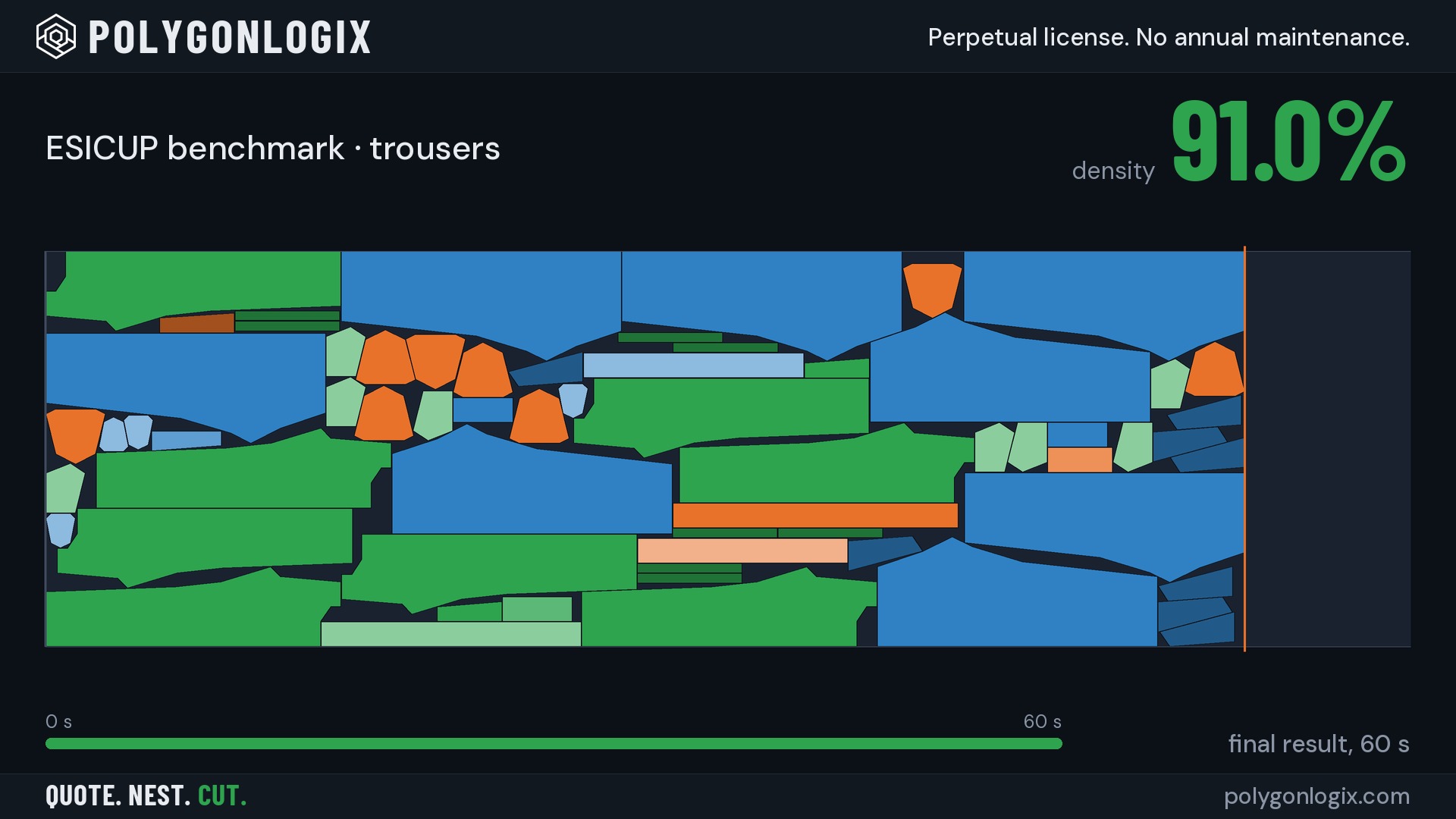
Ten seconds for a quote. A minute for production.
The longer Logix runs, the tighter the nest, and it keeps the best layout it has found at every moment, so you can stop it the second you need the sheet. Most of the density arrives early, which is why a quote can afford to wait ten seconds and a production nest can take the full minute.
Mean density across the ten standard ESICUP nesting tests at each time limit. These are strip-packing problems with no sheet edges and no spacing, so the figure will not match the utilization on your 60 × 120 sheets; it is the one place every engine gets identical parts and identical rules. How the scores were taken.
What you control
The job keeps its settings. Any part can override them, and the choice travels with the part from the quote to the order.
Rotation
Set it for the whole job, or override it for one part: locked as drawn, end-for-end only, 90-degree steps, or every angle the job allows. A part with a grain stays put while everything around it turns.
Mirror
Tick a part that is the same either way and Logix flips it when that packs tighter. Mirror Always flips every copy. The layout report and the part tags say which hand was cut, and a saved nest comes back with the same hand.
Common lineDesktop
Identical parts share one cut at your machine’s real kerf, read from your NC tables. Pierces land in scrap, never on the shared line between two parts. On a plate of 24 rectangles that is 11 pierces instead of 37.
Nest time
Fast for a quote, longer for production, and the same setting whether the job is one sheet or a stack of inventory plates and drops. The last time you chose is remembered, and pressing Nest Parts again stops the run.
The way a job shop actually runs
Quotes that charge for what you use
A small quote is nested onto the strip of sheet it actually fills, in rows or columns, so the sheet usage on the quote is the sheet usage on the floor.
Inventory plates and dropsPro
Nest straight onto the plates and remnants you have in stock, including custom-shaped drops. Each one gets its full share of the nest time.
Fill the gapsPro
Add filler parts from your Part Library to the space left on a production sheet. The nested parts don’t move and no sheet is added; when several fillers fit, they take turns so stock builds evenly.
Imperfect drawings
DXFs with broken or overlapping loops are cleaned on import, or named and held out before the nest, so they never reach the plate. The rest of the job still nests.
Cut paths includedPro
Logix Path lays in lead-ins, corner rounding and tabs on parts that could tip, keeps the head off parts that are already cut, then writes your machine’s program under a short, clean name: 775_0500STL, not a fifty-character string.
Numbers you can check
Every figure here comes from our own shop’s jobs or the published benchmark, where every layout is scored by a check that is separate from the engine.
Pierces on a 24-piece plate of plain rectangles with common line on.
Fewer pierces across 92 real shop jobs with common line on: 137,862 where there were 161,560.
Less sheet charged on small quotes, now that a quote is nested onto the strip it fills: 3.8% less sheet area on our small-quote test jobs.
Less plate than our previous engine on 92 of our own production jobs at a 60-second nest time: 474 sheets against 487.
Mean density on the ten ESICUP benchmark tests at 60 seconds each. The open-source research solver sparrow scored 86.7% on the same PC in the same time; its authors report 88.2% when it gets 20 minutes per test.
November 2026
- Mirror and rotation, set per part
- Common line at your real kerf, with every pierce in scrap
- Sheet usage on small quotes that matches the floor
- Short program names, with a material code you set once
- Full nest time on inventory plates, sheet stacks and custom drops
Read the release post for what each change looks like on your plate, or see everything else in the release.
Count the sheets on your own job
Send us one of your jobs and we’ll nest it with Logix and send the layout back, no strings. Or try it yourself in Lite: a 7-day free trial, no card needed.